The "Z Plan" Story
Japan's 1944 Naval Battle Strategy Drifts into U.S. Hands, Part 2
Thursday, June 11, 2009

Sunday, June 07, 2009
Australia invades Syria
Chapter 17
THE FIRST DAY
8 June THE OPPOSING FORCES 359
At the end of the first day, however, it seemed evident that Syria would have to be won by military not political operations . The French had shown that they would resist. Consequently, since the French deployed 18 good battalions of regulars against 9 good Australian, Indian an d British battalions, and 6 Free French battalions of doubtful quality, the "armed political inroad" which Churchill had advocated was likely to develop into a hard-fought campaign.
bombardments of Sydney and Newcastle.
On Monday, 8th June, the Japanese submarines varied their attacks on the east coast of Australia by carrying out brief bombardments of Sydney and Newcastle. At 12.15 a.m. the Sydney examination vessel, H.M.A.S. Adele, sighted flashes of gunfire about nine miles S.E. by S. of Macquarie
78 AUSTRALIA'S COASTS RAIDED 8-12 Jun
Light, and approximately four miles east of Cape Banks. Between then and 12.20 a.m., ten shells, only four of which exploded, one harmlessly, fell in the Rose Bay and Bellevue Hill areas.
78 AUSTRALIA'S COASTS RAIDED 8-12 Jun
Light, and approximately four miles east of Cape Banks. Between then and 12.20 a.m., ten shells, only four of which exploded, one harmlessly, fell in the Rose Bay and Bellevue Hill areas.
Saturday, June 06, 2009
Both beaches on D plus 1 were still under enemy artillery fire.
Securing the Beachheads
Supreme in the air, the Allies began on D Day to build up a similarly crushing superiority on the ground. By the end of 6 June 1944 First Army had succeeded in landing most of eight and a third infantry regiments-only a little less than planned. For operations on 7 June five divisions were ashore and operational (although one, the 29th, lacked one of its regiments until later in the day). All of these divisions were seriously deficient in transport, tank support, artillery, and above all supplies. The worst situation was in the V Corps zone where, of 2,400 tons of supplies planned to be unloaded during D Day, only about 100 tons actually came in. Ammunition shortage was grave. Both beaches on D plus 1 were still under enemy artillery fire. On OMAHA pockets of enemy riflemen still held out at various points along the coast; beach obstacles, even after work by the engineers during low tide of the afternoon of D Day, were still only about a third cleared; beach exits had not been opened as scheduled nor vehicle parks established inland on the scale contemplated.
Supreme in the air, the Allies began on D Day to build up a similarly crushing superiority on the ground. By the end of 6 June 1944 First Army had succeeded in landing most of eight and a third infantry regiments-only a little less than planned. For operations on 7 June five divisions were ashore and operational (although one, the 29th, lacked one of its regiments until later in the day). All of these divisions were seriously deficient in transport, tank support, artillery, and above all supplies. The worst situation was in the V Corps zone where, of 2,400 tons of supplies planned to be unloaded during D Day, only about 100 tons actually came in. Ammunition shortage was grave. Both beaches on D plus 1 were still under enemy artillery fire. On OMAHA pockets of enemy riflemen still held out at various points along the coast; beach obstacles, even after work by the engineers during low tide of the afternoon of D Day, were still only about a third cleared; beach exits had not been opened as scheduled nor vehicle parks established inland on the scale contemplated.
Rudd boats keep coming so Debus thrown overboard
Debus thrown overboard
But Home Affairs Minister Bob Debus and Parliamentary Secretary for Health and Ageing Jan McLucas are not in the new look front bench, under the changes announced in Brisbane today.
Mr Rudd said Mr Debus would not re-contest his NSW-based seat of Macquarie at the next election and would retire after nearly 28 years in NSW and federal politics.
Friday, June 05, 2009
The Invasion Is Launched
The Sixth of June
Cross-Channel Attack
The Airborne Assault
The time and place at least of the "large-scale landing" caught the Germans wholly by surprise.
Hitting the Beaches
While U.S. airborne troops dropped on the Cotentin and British paratroopers landed near Caen, the invasion fleet was bringing the main body of the Allied armies to the shores of Normandy.
In these first few hours on OMAHA Beach, the OVERLORD operation faced its gravest crisis.
Thursday, June 04, 2009
D-Day 5 June 1944
On 8 May General Eisenhower set D Day for Y plus 4, or 5 June.
General Eisenhower cabled General Marshall on Saturday, 3 June: "We have almost an even chance of having pretty fair conditions . . . only marked deterioration . . . would discourage our plans." But marked deterioration was already in the cards. That Saturday evening Group Captain Stagg again came before the Supreme Commander and his commanders in chief who were meeting at Southwick House north of Portsmouth, the headquarters of Admiral Ramsay. Group Captain Stagg had bad news.
Not only would the weather on 5 June be overcast and stormy with high winds and a cloud base of 500 feet to zero, but the weather was of such a nature that forecasting more than twenty-four hours in advance was highly undependable. The long period of settled conditions was breaking up. It was decided, after discussion, to postpone decision for seven hours and in the meantime let Force U and part of Force O sail on schedule for their rendezvous for the June D Day.
At 0430 Sunday morning a second meeting was held at which it was predicted that the sea conditions would be slightly better than anticipated but that overcast would still not permit use of the air force. Although General Montgomery then expressed his willingness to go ahead with the operation as scheduled, General Eisenhower decided to postpone it for twenty-four hours. He felt that OVERLORD was going in with a very slim margin of ground superiority and that only the Allied supremacy in the air made it a sound operation of war. If the air could not operate, the landings should not be risked. A prearranged signal was sent out to the invasion fleet, many of whose convoys were already at sea. The ships turned back and prepared to rendezvous twenty-four hours later.
On Sunday night, 4 June, at 2130 the high command met again in the library of Southwick House. Group Captain Stag reported a marked change in the weather. A rain front over the assault area was expected to clear in two or three hours and the clearing would last until Tuesday morning.
Wednesday, June 03, 2009
Battle of Midway: 4-7 June 1942
The Battle of Midway, fought near the Central Pacific island of Midway, is considered the decisive battle of the war in the Pacific.
Tuesday, June 02, 2009
Sun is at a fifty year low.
Why has the Sun been so quiet recently?
No one is sure. Our Sun has shown few active regions -- that house even fewer associated sunspots -- for over a year now, and such a period of relative calm is quite unusual. What is well known is that our Sun is in a transitional period between solar cycles called a Solar Minimum, where solar activity has historically been reduced. The stark lack of surface tumult is unusual even during a Solar Minimum, however, and activity this low has not been seen for many decades. A few days ago, however, a bona-fide active region -- complete with sunspots --appeared and continues to rotate across the Sun's face. Visible above, this region, dubbed Active Region 1002 (AR 1002), was imaged in ultraviolet light yesterday by the SOHO spacecraft, which co-orbits the Sun near the Earth. Besides the tranquility on the Sun's surface, recent data from the Ulysses spacecraft, across the Solar System, indicate that the intensity of the solar wind blowing out from the Sun is at a fifty year low. Predictions hold, however, that our Sun will show more and more active regions containing more and more sunspots and flares until Solar Maximum occurs in about four years.
No one is sure. Our Sun has shown few active regions -- that house even fewer associated sunspots -- for over a year now, and such a period of relative calm is quite unusual. What is well known is that our Sun is in a transitional period between solar cycles called a Solar Minimum, where solar activity has historically been reduced. The stark lack of surface tumult is unusual even during a Solar Minimum, however, and activity this low has not been seen for many decades. A few days ago, however, a bona-fide active region -- complete with sunspots --appeared and continues to rotate across the Sun's face. Visible above, this region, dubbed Active Region 1002 (AR 1002), was imaged in ultraviolet light yesterday by the SOHO spacecraft, which co-orbits the Sun near the Earth. Besides the tranquility on the Sun's surface, recent data from the Ulysses spacecraft, across the Solar System, indicate that the intensity of the solar wind blowing out from the Sun is at a fifty year low. Predictions hold, however, that our Sun will show more and more active regions containing more and more sunspots and flares until Solar Maximum occurs in about four years.
Monday, June 01, 2009
GM financially overextended again.
General Motors
In 1910, Durant became financially overextended and banking interests assumed control, forcing him from management of GM.
In 1910, Durant became financially overextended and banking interests assumed control, forcing him from management of GM.
Thursday, May 28, 2009
Influenza CSL and court martial of ALP MP
Chapter XXI – The War Ends
Feb, 1919-July, 1921] THE WAR ENDS 1073
The greatest strain on the discipline of the force actually came when transports reached Australia and, sometimes through the detection of a single case of influenza, were quarantined although the epidemic was already beginning to spread throughout the country. It is said that by delaying the epidemic the quarantine probably saved Australia a heavy toll of life. 92 The officers, ships’ captains and quarantine authorities organised what amusements they could and the trial was generally borne with astonishing good humour. 93
92 This is discussed in Vol. III of the Official Australian Medical History, now being prepared for publication.
In Chapter XV – Medical Problems in Australia
We read
"The application of maritime quarantine from the 17th of October 1918 was an endeavour to prevent the entry of that type of influenza. During the seven months from October 1918 to April 1919 the quarantine service dealt with 149 uninfected vessels and 174 infected vessels, with a total personnel of 81,510 including 1,102 actual patients."
We also read
“Under its control, besides quarantine and the Australian Institute of Tropical Medicine, came the Commonwealth Serum Laboratories. The laboratories were themselves a very important outcome of the First World War. The following account of their institution is authoritative:
Towards the end of 1914, it became apparent that supplies of biological products especially diphtheria and tetanus anti-toxins, would be available in Australia only in limited quantities, if at all. The war situation had produced such demands on European and American supplies for British and French use that Australia was in danger of being left without any. Accordingly, after consultation with one or two people interested, Dr. Cumpston recommended to the Minister that the Government itself should immediately set about production so that it should never be caught in the some position again. This was agreed to and Dr. Cumpston was given a fairly free hand as to expenditure and staff. The building was opened for work while the war was still in progress; the first contribution on any large scale was the preparation of large quantities of influenza vaccine to meet the epidemic of 1918-19. The development of these laboratories proceeded with many initial difficulties, but with such ultimate success until, during the Second World War, they have supplied not only all Australia’s own requirements, both for the services and for civil needs, and for troops abroad as well as at home, but also most of the needs of the Government of New Zealand, Hong Kong, Malaya, Dutch East Indies and India.93 In one case, that of the transport Somali, which arrived at Adelaide on Jan. 28, serious trouble took place. No case of influenza had occurred since the ship left Fremantle. The troops believed that quarantine at Adelaide would be avoided by continuous submission to treatment; but after two days’ delay, although an informal message was received that the South Australians were to be taken off and the ship allowed to go on, this was not carried out. On the 30th the troops threatened to take control of the ship. One of the leaders, a member of the Federal Parliament, Gnr. G. E. Yates, was afterwards tried by court martial and spent a month in detention, but through the death of his father was released before his full term ended.At the AEC we read G E Yates (ALP) 1914-19 and G E Yates (ALP) 1922-31
Tuesday, May 26, 2009
He was and remains a mysterious figure..
Wilder-Neligan, Maurice (1882 - 1923)
He was and remains a mysterious figure, save for the brief years of his military achievement.
From the landing on Gallipoli on 25 April he was in his element.
After recovering, he took part in desperate fighting at Bullecourt in May 1917 and in the 3rd battle of Ypres. For brief periods that year he was acting commanding officer of the 9th Battalion and of the 10th. Promoted lieutenant-colonel, he returned to the 10th on 30 June as its commander; 'within a few months [he] infused into that battalion a special eagerness'. His determined and imaginative training prepared it for the battle of Polygon Wood in September—with brilliant results.
To C. E. W. Bean he was 'a restless and adventurous spirit', 'an impetuous, daredevil officer but free of the carelessness with which those qualities are often associated'. His eccentricities were famous and were often shown in the embarrassing way he treated his officers, but much was forgiven so masterly a commander. If the rank and file cursed him, they also trusted him.
Monday, May 25, 2009
Kim il? Too many blonde jokes?
Kim Jong-il - Wikipedia, the free encyclopedia
Too many blonde jokes? He is rumoured to like Swedish blondes.
Oh, if MacArthur had been allowed total victory in Korea. He wanted to defeat communism in East Asia. He wanted to bomb Chinese bases in Manchuria and block Chinese ports. President Truman and his military advisers were concerned World War Three would start. Now World War Three from sick Kim?
Saturday, May 23, 2009
the Beguine Begin, May 23, 1910
Artie Shaw
From Wikipedia, the free encyclopedia
May 23, 1910, New York, New York - December 30, 2004, Thousand Oaks, California
From Wikipedia, the free encyclopedia
May 23, 1910, New York, New York - December 30, 2004, Thousand Oaks, California
Wednesday, May 20, 2009
no-man’s-land was strewn with Turks
ANZAC TO AMIENS [19th-24th May 1915
Chapter IX – Holding on at Anzac
But no-man’s-land was strewn with Turks. Of the 42,000 - two old and two fresh divisions - that attacked, 10,000 were hit, 3000 (it is said) being killed.
Chapter IX – Holding on at Anzac
But no-man’s-land was strewn with Turks. Of the 42,000 - two old and two fresh divisions - that attacked, 10,000 were hit, 3000 (it is said) being killed.
Friday, May 15, 2009
General Bridges, born 150 years ago today
William Throsby Bridges, was born 150 years ago today. He as a Australian General was shot by a Turkish sniper.
Chapter IV – The Problem of Monash Valley
15th May, 1915] PROBLEM OF MONASH VALLEY 129
As he went up the road with Colonel White and Lieutenant Casey (his A.D.C.) they met Major William Glasgow, 75 of the 1st Light Horse Regiment, with some of his men on their way down. “Be careful of the next corner,” he said, “ I have lost five men there to-day.’’ Such warnings, which were constantly heard by anyone visiting the trenches, were usually little heeded. But this particular officer was not one who would give idle advice. When, therefore, they reached a traverse 200 yards below Chauvel’s headquarters, and some men behind the next barrier advised them to run to it, General Bridges, to the surprise of his companions, adopted the suggestion. His ordinary practice had been to expose himself without regard for danger, laughing down at his staff when they took cover, and asking “what they were getting down there for?” But he had apparently begun to realise that this impunity could not continue. 76
On this day, probably guessing from a certain vague tension in the valley that the danger was real, he acted upon the advice tendered The party ran three or four times between barriers, until they reached the one below Steele’s Post. Behind this was the dressing-station of Captain Thompson of the 1st Battalion. After talking a few minutes and lighting a cigarette Bridges went on, Thompson warning him to be careful. The general’s long legs disappeared in the scrub round the traverse, and the others were preparing to follow, when there was some sort of stir, and Thompson ran out to find Bridges lying with a huge bullet-hole through his thigh. Both femoral artery and vein had been cut, and, though Thompson instantly stopped the bleeding, the loss of blood had been very great. As they brought the general back into the shelter of the traverse, strangely changed from the bronzed healthy man who had passed a few seconds before, he said weakly, “ Don’t carry me down-I don’t want any of your stretcher-bearers hit.”
Colonel White had the traffic in the gully stopped, so that it should be clear to the Turks that the only movement was
130 THE STORY OF ANZAC [15th May, 1915
the carrying of a wounded man, and then the party moved slowly to the Beach. The Turks, whether by accident or by a forbearance which they sometimes showed, did not fire upon it. Bridges was taken at once to the hospital ship Gascon. But the whole blood-supply to the limb had been cut off, and nothing could save his life except complete amputation at the thigh, an operation which, it was considered, to a man of his years, must prove fatal. Before the Garcon left for Alexandria he knew he was dying. “Anyhow,” he said to Colonel Ryan, “anyhow, I have commanded an Australian Division for nine months.” He died before the ship reached port. His body was brought to Australia 77 and buried on the hill above the military college at Duntroon, which he had founded. Bridges’ habit of exposing himself to danger had made it from the first unlikely that he would survive many months: of fighting. Had he done so, it is probable that he would have emerged the greatest of Australia’s soldiers, as he was certainly the most profound of her military students. His powerful mind and great knowledge were supported by outstanding moral and physical courage, and also by a ruthless driving force, rare in students. Only in Haig and Allenby did Australians meet any commander whose forcefulness equalled that of Bridges. His defect as a leader-the inability to display those qualities which would make the ordinary man love and follow him-was finding its compensation in the conspicuous bravery with which, since the Landing, he had won the admiration of the troops.
Upon Bridges’ death the command of the 1st Australian Division temporarily passed, in accordance with the general expectation of those at Anzac, to Brigadier-General H. B. Walker, of the 1st Infantry Brigade, an officer who, by his directness, his fighting qualities, and his consideration for his men, had in a few weeks much endeared himself to the troops. This promotion left vacant the command of the 1st Brigade. Most of the battalions of the division were at this time commanded by officers who were either rather too old to possess the necessary vigour, or had been newly promoted in place of those killed, wounded, or unequal to the test of war.
Chapter IV – The Problem of Monash Valley
15th May, 1915] PROBLEM OF MONASH VALLEY 129
As he went up the road with Colonel White and Lieutenant Casey (his A.D.C.) they met Major William Glasgow, 75 of the 1st Light Horse Regiment, with some of his men on their way down. “Be careful of the next corner,” he said, “ I have lost five men there to-day.’’ Such warnings, which were constantly heard by anyone visiting the trenches, were usually little heeded. But this particular officer was not one who would give idle advice. When, therefore, they reached a traverse 200 yards below Chauvel’s headquarters, and some men behind the next barrier advised them to run to it, General Bridges, to the surprise of his companions, adopted the suggestion. His ordinary practice had been to expose himself without regard for danger, laughing down at his staff when they took cover, and asking “what they were getting down there for?” But he had apparently begun to realise that this impunity could not continue. 76
On this day, probably guessing from a certain vague tension in the valley that the danger was real, he acted upon the advice tendered The party ran three or four times between barriers, until they reached the one below Steele’s Post. Behind this was the dressing-station of Captain Thompson of the 1st Battalion. After talking a few minutes and lighting a cigarette Bridges went on, Thompson warning him to be careful. The general’s long legs disappeared in the scrub round the traverse, and the others were preparing to follow, when there was some sort of stir, and Thompson ran out to find Bridges lying with a huge bullet-hole through his thigh. Both femoral artery and vein had been cut, and, though Thompson instantly stopped the bleeding, the loss of blood had been very great. As they brought the general back into the shelter of the traverse, strangely changed from the bronzed healthy man who had passed a few seconds before, he said weakly, “ Don’t carry me down-I don’t want any of your stretcher-bearers hit.”
Colonel White had the traffic in the gully stopped, so that it should be clear to the Turks that the only movement was
75 Afterwards Maj.-Gen Sir T. W Glasgow, commanding 1st Aust. Div.
76 A few days previously, when a shrapnel shell had burst very near, Col Howse. one of his few intimate friends, had said, General, you’ll be caught if you go risking any more of those.” Nex:t day, when Col. White during a burst of shell-fire advised his chief not to "give the Turks the chance they wanted," Bridges had consented to take cover till the shelling was over.
130 THE STORY OF ANZAC [15th May, 1915
the carrying of a wounded man, and then the party moved slowly to the Beach. The Turks, whether by accident or by a forbearance which they sometimes showed, did not fire upon it. Bridges was taken at once to the hospital ship Gascon. But the whole blood-supply to the limb had been cut off, and nothing could save his life except complete amputation at the thigh, an operation which, it was considered, to a man of his years, must prove fatal. Before the Garcon left for Alexandria he knew he was dying. “Anyhow,” he said to Colonel Ryan, “anyhow, I have commanded an Australian Division for nine months.” He died before the ship reached port. His body was brought to Australia 77 and buried on the hill above the military college at Duntroon, which he had founded. Bridges’ habit of exposing himself to danger had made it from the first unlikely that he would survive many months: of fighting. Had he done so, it is probable that he would have emerged the greatest of Australia’s soldiers, as he was certainly the most profound of her military students. His powerful mind and great knowledge were supported by outstanding moral and physical courage, and also by a ruthless driving force, rare in students. Only in Haig and Allenby did Australians meet any commander whose forcefulness equalled that of Bridges. His defect as a leader-the inability to display those qualities which would make the ordinary man love and follow him-was finding its compensation in the conspicuous bravery with which, since the Landing, he had won the admiration of the troops.
Upon Bridges’ death the command of the 1st Australian Division temporarily passed, in accordance with the general expectation of those at Anzac, to Brigadier-General H. B. Walker, of the 1st Infantry Brigade, an officer who, by his directness, his fighting qualities, and his consideration for his men, had in a few weeks much endeared himself to the troops. This promotion left vacant the command of the 1st Brigade. Most of the battalions of the division were at this time commanded by officers who were either rather too old to possess the necessary vigour, or had been newly promoted in place of those killed, wounded, or unequal to the test of war.
77 Upon a suggestion made in Parliament by the Hon. Littleton E. Groom
Saturday, May 09, 2009
Anzac E. L. Margolin, b. Central Russia
Chapter IV – The Problem of Monash Valley
9th-10th May, 1915] PROBLEM OF MONASH VALLEY 107
In consequence Colonel Cannan despatched to him Lieutenant Harwood, with thirty men of the 16th, and ordered patrols to be sent by the centre party towards the left and vice versa. As no word of these came back, Major Margolin 41 was next sent with a further thirty under orders to enter Frank Armstrong’s trench and advance along it to the left, so as to link up. But on reaching Armstrong’s trench Margolin found it so crowded that there was no room for his men, who had to lie down outside. Stumbling upon Harwood’s party lying in the same manner in the old No-Man’s Land, he set it to assist in digging the central communication trench. Then, since his own men were being uselessly killed, he returned to Cannan, and was instructed to withdraw them. Searching the space between the trenches with a faithful assistant,
108 THE STORY OF ANZAC [10th May, 1915
Signaller Silas, he succeeded in getting forty men of the 16th back to Quinn's.
9th-10th May, 1915] PROBLEM OF MONASH VALLEY 107
In consequence Colonel Cannan despatched to him Lieutenant Harwood, with thirty men of the 16th, and ordered patrols to be sent by the centre party towards the left and vice versa. As no word of these came back, Major Margolin 41 was next sent with a further thirty under orders to enter Frank Armstrong’s trench and advance along it to the left, so as to link up. But on reaching Armstrong’s trench Margolin found it so crowded that there was no room for his men, who had to lie down outside. Stumbling upon Harwood’s party lying in the same manner in the old No-Man’s Land, he set it to assist in digging the central communication trench. Then, since his own men were being uselessly killed, he returned to Cannan, and was instructed to withdraw them. Searching the space between the trenches with a faithful assistant,
41 Lieut.-Col. E. L. Margolin, D.S.O. Merchant: of Collie, W. Aust., b. Bielgorod, Central Russia, 26 March. 1875.
108 THE STORY OF ANZAC [10th May, 1915
Signaller Silas, he succeeded in getting forty men of the 16th back to Quinn's.
Friday, May 08, 2009
Anzac N T Svensen b Larvik, Norway
Chapter IV – The Problem of Monash Valley
9th May, 1915] PROBLEM OF MONASH VALLEY 105
On the declivity beside several dugouts was a heap of spoil, and above it the mouth of a tunnel. into which Corporal Tickner fired, but without drawing a reply. According to one account, after the valley had been cleared of Turks and picqueted, a messenger reached Armstrong warning him that he was too far advanced. At all events he reassembled his party and returned to the Australian line. The raid had no doubt crushed the enemy’s local defence system upon that flank of Quinn’s. The Queenslanders had lost few men, and eventually, reinforced by some of Lieutenant Svensen’s 34 men from the right trench of Quinn’s, helped to garrison its proper section of the new line, while Svensen strung out other men across No-Man’s Land to dig a communication trench from the right of Quinn’s to the captured position.
34 Lieut. N T Svensen, 15th Bn Draughtsman, of South Brisbane, b Larvik, Norway, 17 Sept , 1878.
Thursday, May 07, 2009
...a solitary Turk with a number of waterbottles..
May,1915] CHANGE TO TRENCH-WARFARE 47
Men of the 1st Brigade were sapping across one small gap on Maclaurin’s where on May 7th there remained five yards to be completed. A further negligible interval at the “nick’’ of Wire Gully remained to the end of the campaign filled only with barbed wire. 5 South of this, across the 400 Plateau, the trenches were now continuous.
In the last of the four sections, the Right, which began immediately south of the 400 Plateau and ran along Bolton’s Ridge to a point above the sea, the troops, as on the extreme left, had been comparatively uninterrupted, and their trenches were consequently deep and secure. A few posts on the steep
5 On a day in May men sitting in their dugouts above Bridges’ Road (the valley on the Anzac side of this gap) saw a solitary Turk with a number of waterbottles slung round him standing in this nick above them and looking down on the scene as if dazed. He had evidently been sent to bring water to the Turkish trenches. and, making his way up the wrong gully had found himself in the Australian lines. He dived back and escaped down the enemy’s side of the hill, a few shots ringing after him.
48 THE STORY OF ANZAC [May, 1915
slope above the shore connected the trench-line with a wire entanglement upon the beach, which formed the extreme right flank.
The enemy had at this stage approached the Anzac line very closely at Russell’s Top and in the two Central Sections, but especially in that of Monash’s brigade-the Left Central.
Men of the 1st Brigade were sapping across one small gap on Maclaurin’s where on May 7th there remained five yards to be completed. A further negligible interval at the “nick’’ of Wire Gully remained to the end of the campaign filled only with barbed wire. 5 South of this, across the 400 Plateau, the trenches were now continuous.
In the last of the four sections, the Right, which began immediately south of the 400 Plateau and ran along Bolton’s Ridge to a point above the sea, the troops, as on the extreme left, had been comparatively uninterrupted, and their trenches were consequently deep and secure. A few posts on the steep
5 On a day in May men sitting in their dugouts above Bridges’ Road (the valley on the Anzac side of this gap) saw a solitary Turk with a number of waterbottles slung round him standing in this nick above them and looking down on the scene as if dazed. He had evidently been sent to bring water to the Turkish trenches. and, making his way up the wrong gully had found himself in the Australian lines. He dived back and escaped down the enemy’s side of the hill, a few shots ringing after him.
See Vol I , pp. 350-1.
Chapter XVI – The 3rd Brigade on the“400 Plateau”
From the Razorback the side of the plateau curved northward in front of the 10th to the point where it joined the Second ridge. Braund’s Hill, a minor back-jutting spur of the Second ridge, shut in the valley on the north. Along this valley ran a path, which had evidently been used by the Turks from inland for reaching the shore. The path wound very steeply up to a curious nick in the skyline at the northern corner of the valley-head.
48 THE STORY OF ANZAC [May, 1915
slope above the shore connected the trench-line with a wire entanglement upon the beach, which formed the extreme right flank.
The enemy had at this stage approached the Anzac line very closely at Russell’s Top and in the two Central Sections, but especially in that of Monash’s brigade-the Left Central.
Friday, May 01, 2009
2nd-6th May, 1915
Chapter I – The Struggle for Krithia
4 THE STORY OF ANZAC [2nd-6th May, 1915
Returning to Anzac, Birdwood sent for Bridges and Godley, the commanders of his two divisions, and asked each to withdraw at once from the line his most effective brigade. Bridges chose the 2nd, 5 commanded by Colonel M’Cay. In the N.Z. & A Division the only brigade which could possibly be sent was that of the New Zealand infantry. Although the Otago Battalion had been heavily engaged in the previous night’s attack on Baby 700, the brigade still numbered 2493; the 4th Australian Infantry Brigade, the strength of which had been given on May 2nd as 3,430, was after that fight estimated at no more than 1,811.
The order to withdraw the troops had already been sent out and the Otago Battalion and part of the Canterbury, just emerging from the battle, had been directed to the Beach, when the move was postponed by G.H.Q. The twenty guns, however, were sent on May 4th, and on the same day the arrival of the Fusilier brigade of the 42nd (East Lancashire Territorial) Division, for which he was waiting, enabled Hamilton to determine that the great attempt should be launched on the morning of May 6th. The reinforcement from Anzac was therefore ordered to move south on the night of the 5th. “I am sending my two best brigades,” Birdwood telegraphed.
It was obviously important that the Turks should have no inkling of this transfer, since it would lead them to guess both that the Anzac line had been weakened and that an attack was impending at Helles. It was therefore planned that the troops should embark immediately after nightfall and, making the two-hour’ sea-journey during the dark, should be in bivouac at Helles before daylight. By careful arrangement the brigades, with the bearer sub-divisions” of their respective field ambulances, were relieved, rationed, equipped, and at dusk concentrated beside their boats and lighters at specially marked embarking-points. Unfortunately the destroyers and fleet-sweepers 6 which were to carry them were delayed by heavy seas, although Anzac Cove was as usual protected from the wind. On the Beach, since fires were impossible, the troops sat shivering until midnight, when the
5 The 1st had 2.874 men-as against 2,568 of the 2nd-but its commander Gen Walker was newly-appointed and a British officer, whereas M'Cay was an Australian whose leadership, Bridges thought had been considerably improved by the past week‘s experience in the field. Moreover, M’Cay’s brigade was less disorganised than the 1st
6 Swift packet-boats from England temporarily fitted for mine-sweeping with the fleet.
6th May, 1915] STRUGGLE FOR KRITHIA 5
New Zealanders began to embark. It was plain daylight before the last of the fleet-sweepers carrying the Australians left for Helles.
At the beginning of May, 1915
Chapter I – The Struggle for Krithia
At the beginning of May, 1915, both the forces which had landed a week earlier on the Gallipoli Peninsula had secured a foothold. But neither had approached its objective. Even the positions intended to be reached by the covering forces, namely, Achi Baba at Helles and the “Third” ridges at Anzac, had not been attained. The British had gradually advanced two miles, nearly half of the projected first stage; the Anzac troops remained where all except a few advanced elements had from the earliest hours been ordered to entrench-that is to say, on the “Second” ridge. Of this the main prominence, Baby 700, had been lost in the fierce struggle following the Landing, and the enemy had gained a footing on the almost equally important 400 Plateau and on all parts of the Second ridge between the two. The result was that, while the British foothold at Helles might at the beginning of May be considered secure, that at Anzac, where the enemy dominated the centre of the position, was still tactically unsafe.
At the beginning of May, 1915, both the forces which had landed a week earlier on the Gallipoli Peninsula had secured a foothold. But neither had approached its objective. Even the positions intended to be reached by the covering forces, namely, Achi Baba at Helles and the “Third” ridges at Anzac, had not been attained. The British had gradually advanced two miles, nearly half of the projected first stage; the Anzac troops remained where all except a few advanced elements had from the earliest hours been ordered to entrench-that is to say, on the “Second” ridge. Of this the main prominence, Baby 700, had been lost in the fierce struggle following the Landing, and the enemy had gained a footing on the almost equally important 400 Plateau and on all parts of the Second ridge between the two. The result was that, while the British foothold at Helles might at the beginning of May be considered secure, that at Anzac, where the enemy dominated the centre of the position, was still tactically unsafe.
Wednesday, April 29, 2009
Apr -May, 1915
Chapter XXIV – ANZAC Beach
548 THE STORY OF ANZAC [Apr -May, 1915
Work continued under shrapnel exactly as if the Beach were Collins Street or Circular Quay. On April 27th, when the Turks were delivering their general attack on the trenches, shells burst over the Beach all day. But except during one period of thirty minutes, when work was ordered to cease, the unloading and issuing of supplies and the carrying of rations and ammunition by mule and hand to the hills went on without intermission. The shell fire on the Beach was exceptionally deadly. A high British artillery officer, fresh from the Western front, gave it as his opinion that it was “absolute madness” to disregard it in this manner, and eventually it was ordered that during spasms of shrapnel a whistle should be blown and work should cease. The signal was not greatly regarded. The sight of the beach-workers who did not desist, but who continued to perform their part of the day’s task under the whine of shells and the scatter of pellets, was a never-ending wonder to those who lived on the terraced hillside above them. A similar standard had been set in the front line, and only heavy trial or long strain ever broke it down. The attitude of complete indifference to all casual shell or rifle fire was simply the natural expression of the men’s self-respect. No one liked shell fire, but public opinion demanded that, whatever men felt, not by the flicker of an eyelid must they show it. This attitude cost many casualties, and had to be modified by order from higher quarters. But it never died out in the A.I.F. That careless, easy manner and apparent indifference to shell fire marked the Australians on every battlefield. More than one German officer, captured two years later on Broodseinde Ridge, was profoundly impressed by this quality. “What could we not do with such men!” said one of them to the British officer who interrogated him. The percentage of loss amongst Australian officers and men was high, but it is doubtful if in
25th-30th Apr., 1915] ANZAC BEACH 549
the long run this attitude increased it, whereas its permanent effect upon their morale gave them a formidable fighting value which, during the last year of the war, told sensibly in favour of their side. Another result of the heavy fighting of the landing was that it fixed once and for all the relation of the Australian men to their officers. Until this first actual trial, there had lingered in most Australian battalions a vague resentment against the institution of officers.
Tuesday, April 28, 2009
28th-30th Apr, 1915
Chapter XXIII – The Relief by the Marines
28th-30th Apr, 1915] RELIEF BY THE MARINES 535
A concentration area was fixed at the mouth of Shrapnel Gully and on the folds south of it, and to this for two days there straggled along the Beach or down various tracks from the hilltops individual men, men in twos and threes, men in platoons, with or without officers. Bearded, ragged at knees and elbows, their putties often left in the scrub, dull-eyed, many with blood on cheeks and clothes, and with a dirty field-dressing round arm or wrist, they were far fiercer than Turks to look upon. They had long since taken the wire hoops from their caps in order to break the obvious outline which too often had showed like a disc in the scrub. Many had learned to wear for camouflage a spray of holly over the peaks of their caps or in the bands of their battered and bullet-torn Australian hats. Officers were often indistinguishable from men; buttons were gone, and stars scored in indelible pencil on shoulder-straps became a recognised badge of an officer’s rank. The normally dapper Major Drake Brockman. sitting worn-out at the foot of Pope’s Hill, was accosted by a sergeant-major of the 13th Battalion as he rounded up a ration party. “Come on m’lad; we’re all tired, but we’ve got to get this water up the hill!” Many wandered in a half-sleep, like tired children. When that nurse of his men, Major Brand, gave the last worn-out party under Rafferty biscuits and cheese, cigarettes, and a tot of rum, the men, after beginning to eat, went to sleep with the food still in their hands Corporal Louch, of the 11th, when he stumbled into the trenches from the battle outposts, found a tin of water and then fell asleep. He waked, went down steep paths in the scrubby hillside to the Beach, collected some sticks, lit a fire, boiled a mess-tin of water for tea, and cleaned his rifle while the water was boiling. Then he tried the tea and found he did not want it. He started along the Beach to Hell Spit, dragging his rifle through the sand by its sling and trailing in the other hand the overcoat - either Clarke’s or that of some other man of the 3rd - which he had dragged with him from his pot-hole. His face, cut by a bullet, was caked with blood, and he had a four days’ beard. Some friend passing asked him where Clarke was. “Yes - he’s here,” he replied; and then realised that he had not seen him since reaching the trenches.
536 THE STORY OF ANZAC [25th-30th Apr., 1915
Many of these men came to the Beach as country men come to the city - to a great centre of wonderful sights of which they had heard the vague mention - a scene changed beyond all recognition since the wild rush from the landing place in the dawn. The packs which they had piled there were in many cases long since rifled or scattered, for the sentries guarding them had been rounded up on the first night and sent to the firing line. But men met friends and mates whom they had little thought to see again. Often each group had imagined itself to comprise all the survivors of the battalion. The concentration area was under intermittent shrapnel and sprayed with a desultory fire from unaimed or distant rifles. But they heeded all this less than the drops of a summer shower. All day the men swam, washed, mended their clothes, and gave one another the benefit of their experiences. The roll of each battalion was called. On the average it had entered the fight with thirty officers and 930 men.
Of the missing a proportion were afterwards found to have been sent away wounded without any record being kept. The rest were dead. Of 5,000 who were lost in the 1st Australian Division only one man was a prisoner.
Monday, April 27, 2009
27th-28th Apr., 1915
27th-28th Apr., 1915] SECOND COUNTER-ATTACK 523
Majors Wagstaff and Blamey, of the Staff, gathered what men they could and hurried to the line with them. But they were not needed. The immediate supports of the firing line had been waiting all day close behind the crest of MacLaurin’s Hill, expecting every minute to make a bayonet charge. During the night these weary men were dragged out again and again to stand on the rear slope, their bayonets shining in the moonlight. Once a cheer was heard on the left. It was a local charge by some 200 of the 3rd Battalion and others for the purpose of clearing their front, but the nucleus of the 12th, now in the trenches near Wire Gully, thought this must surely be the great charge which was to meet the Turkish attack. They therefore left their trenches and ran forward a dozen paces. It was intensely dark ; no one could be seen ; and consequently they returned. But there was no sleep. Cries of “Stretcher-bearers on the left’’---“Another machine-gun man wanted”-“Turks massing on the right”- travelled constantly along the line. Margetts was found by a friend standing, one hand with his revolver resting on the parapet, his head on his arm, asleep. When daylight broke, it was evident that the Turkish attack was dead. Its only result had been that the Turkish snipers were again on Russell’s Top, and, as the light grew, the 12th had five men on the reverse slope hit within an hour by shots coming from the rear. These casualties were treated as trifles. The serious fact was that by Wednesday morning men and officers were reaching the limit of human endurance. Some of the steadiest could scarcely trust their eyes or decide whether the sights they saw were realities or creations of their imagination. The men were constantly looking for the appearance of British troops on Achi Baba and other heights to the south of them. At dusk on Tuesday Colonel Owen telegraphed to Bridges: “Men tired out and weak, but will do their best. Can I tell them that British will be up by morning to relieve pressure?” The reply was that he should tell them that fresh British troops were expected to arrive on the morrow.
Majors Wagstaff and Blamey, of the Staff, gathered what men they could and hurried to the line with them. But they were not needed. The immediate supports of the firing line had been waiting all day close behind the crest of MacLaurin’s Hill, expecting every minute to make a bayonet charge. During the night these weary men were dragged out again and again to stand on the rear slope, their bayonets shining in the moonlight. Once a cheer was heard on the left. It was a local charge by some 200 of the 3rd Battalion and others for the purpose of clearing their front, but the nucleus of the 12th, now in the trenches near Wire Gully, thought this must surely be the great charge which was to meet the Turkish attack. They therefore left their trenches and ran forward a dozen paces. It was intensely dark ; no one could be seen ; and consequently they returned. But there was no sleep. Cries of “Stretcher-bearers on the left’’---“Another machine-gun man wanted”-“Turks massing on the right”- travelled constantly along the line. Margetts was found by a friend standing, one hand with his revolver resting on the parapet, his head on his arm, asleep. When daylight broke, it was evident that the Turkish attack was dead. Its only result had been that the Turkish snipers were again on Russell’s Top, and, as the light grew, the 12th had five men on the reverse slope hit within an hour by shots coming from the rear. These casualties were treated as trifles. The serious fact was that by Wednesday morning men and officers were reaching the limit of human endurance. Some of the steadiest could scarcely trust their eyes or decide whether the sights they saw were realities or creations of their imagination. The men were constantly looking for the appearance of British troops on Achi Baba and other heights to the south of them. At dusk on Tuesday Colonel Owen telegraphed to Bridges: “Men tired out and weak, but will do their best. Can I tell them that British will be up by morning to relieve pressure?” The reply was that he should tell them that fresh British troops were expected to arrive on the morrow.
26th-27th Apr. 1915 “ANZAC” AND HELLES
ANZAC to Amiens - Chapter VIII – “Anzac” and Helles
On the third day, April 27th, Mustafa Kemal, having been reinforced by two regiments, attempted a general counter-attack. But the warships’ guns caught the main attack as it tried to move down Baby 700 and scattered the Turks like ants on a disturbed anthill - after this experience never again until August did the Turks at Anzac attempt to move down slopes exposed to the warships’ guns. At Quinn’s and the posts south of it they were mown down by rifle fire; and on the right, where they again attacked by night, an Australian battery, which by then Lieut.-Colonel C. Rosenthal had managed to have dragged to the firing line, helped to sweep other assaulting lines away.
Along much of the front the garrison was not even aware it had been attacked.
Sunday, April 26, 2009
25th-26th Apr., 1915
25th-26th Apr., 1915] KEMAL‘S COUNTER-ATTACK 461
About 2.30 a.m. those juniors or other outsiders who were awake round the headquarters of the 1st Australian Division noticed a certain stir. Either Bridges, who had been to Birdwood’s headquarters, had returned or some message from him had arrived. The voice of someone in the general’s dug-out was heard reading an order to be sent out to the troops upon the ridges: “Sir Ian Hamilton hoped that they would dig in, and that the morning would find them securely in their positions. . . .”
About 2.30 a.m. those juniors or other outsiders who were awake round the headquarters of the 1st Australian Division noticed a certain stir. Either Bridges, who had been to Birdwood’s headquarters, had returned or some message from him had arrived. The voice of someone in the general’s dug-out was heard reading an order to be sent out to the troops upon the ridges: “Sir Ian Hamilton hoped that they would dig in, and that the morning would find them securely in their positions. . . .”
Friday, April 24, 2009
Anyhow Tim Blair
Tim Blair: Try and pry these smokes away

http://www.backtobelmore.com.au/images/tlbottom.jpg

http://www.backtobelmore.com.au/images/newarea1.jpg
You get a better view of the word Winfield painted on the stand, from train passing Belmore Sports Ground which is the headquarters of the Canterbury Bulldogs. Anyhow Winfield appreciate the advertising.
Wednesday, April 22, 2009
Tuesday, April 21, 2009
Robin Rudd helps the poor.
Crackdown on tax loopholes for rich
The federal government is set to crackdown on wealthy Australians exploiting tax loopholes.
The federal government is set to crackdown on wealthy Australians exploiting tax loopholes.
Monday, April 20, 2009
Rudd Recession Debt Is A Burnin' Thing
Recession inevitable, Rudd says
Debt Is A Burnin' Thing It Makes A Fiery Ring. Bound By Wild Desire. Oh, That Ring Of Mire. I Fell Into A Burnin' Ring Of Mire I Went Down, Down, Down And The Debts Went Higher. And It Burns, Burns, Burns, That Ring Of Mire That Ring Of Mire. The Taste Of Debt Is Sweet When Hearts Like Ours Meet I Fell In Just Like A Child. Oh, The Flames Went Wild.
Words adapted from "Ring of Fire" is a country music song popularized by Johnny Cash and co-written by June Carter (wife of Johnny Cash) and Merle Kilgore.
Sunday, April 19, 2009
Senior Rudd sauces flavour boaties story.
Asylum explosion a threat gone wrong
Senior govt sources say an explosion that sank a boat, killing 5 asylum seekers, was the result of a threat gone tragically wrong.
Senior govt sources say an explosion that sank a boat, killing 5 asylum seekers, was the result of a threat gone tragically wrong.
Saturday, April 18, 2009
Kevin is the shepherd I did not want.
PSALM 2009
FIRST BOOK OF GOVERNMENT
Kevin is the shepherd I did not want.
He leadeth me beside the still factories.
He restoreth my faith in the Liberal party.
He guideth me in the path of unemployment for his party's sake.
Yea, though I walk through the valley of the bread line,
I shall fear no hunger for his bailouts are with me.
He has anointed my income with taxes,
My expenses runneth over.
Surely, poverty and hard living will follow me all the days of my life
And I will live in a rented home forever.
I am glad I am Australian,
I am glad that I am free.
But I wish I was a dog
and Kevin was a tree
Friday, April 17, 2009
Rudderless overboard.
AFP warned PM about border changes
There are reports the AFP warned the PM that Australia's border protection laws are a magnet for people smuggling.
There are reports the AFP warned the PM that Australia's border protection laws are a magnet for people smuggling.
New Bligh mutiny over bounty.
Queensland pay row
Queensland public servants are threatening six months of rolling strikes, if the state Government strips them of pay entitlements.
Queensland public servants are threatening six months of rolling strikes, if the state Government strips them of pay entitlements.
Krudd 'scum of the earth'? Yes!
People smugglers 'scum of the earth'
Aust PM: People smugglers 'scum of the earth'
7 hours ago
SYDNEY (AFP) — Australian Prime Minister Kevin Rudd Friday insisted his government was tough on immigration, labelling people smugglers as "scum of the earth" in the wake of a deadly blast aboard an intercepted boat.
Aust PM: People smugglers 'scum of the earth'
7 hours ago
SYDNEY (AFP) — Australian Prime Minister Kevin Rudd Friday insisted his government was tough on immigration, labelling people smugglers as "scum of the earth" in the wake of a deadly blast aboard an intercepted boat.
Thursday, April 16, 2009
Wednesday, April 15, 2009
Asylum-seekers miss Debus
Asylum-seekers 'dead, injured' in explosion
Home Affairs Minister Bob Debus is expected to release a statement shortly.
Home Affairs Minister Bob Debus is expected to release a statement shortly.
Tuesday, April 14, 2009
Monday, April 13, 2009
Rudd one man band says don't go
Rudd upgrades Thailand travel advisory
The Rudd Government has upgraded its travel advisory for Thailand, in the wake of fresh clashes between anti government protestors and the military in the capital Bangkok.
In a revised travel advisory, DFAT recommends travellers 'exercise a high degree of caution because of the political instability in Thailand and the possibility of political demonstrations'.
It seems to be a one man band.
Sunday, April 12, 2009
Saturday, April 11, 2009
Super Kev: bird, plane, no pie-in-the-sky.
"Easter Rudd delivers rotten eggs."
"Pie-in-the-sky is not very sustaining."
"Pie-in-the-sky is not very sustaining."
Rudd first Fiji then cat now chaotic situation.
Kevin Rudd condemns Fiji president for removing government
Cat tongue Kev says "Time to lend hand" but then Rudd changed his course in the middle of his flight to Thailand and returned home late Saturday afternoon, due to the chaotic situation in Thailand.
Cat tongue Kev says "Time to lend hand" but then Rudd changed his course in the middle of his flight to Thailand and returned home late Saturday afternoon, due to the chaotic situation in Thailand.
Thursday, April 09, 2009
Rudd ends another visit to Australia
Rudd to meet with Asian leaders
The prime minister will travel to the Thai resort town of Pattaya tomorrow, ahead of Sunday's summit which brings together leaders from the 10 ASEAN nations plus Australia, New Zealand, Japan, China, South Korea and India.
The prime minister will travel to the Thai resort town of Pattaya tomorrow, ahead of Sunday's summit which brings together leaders from the 10 ASEAN nations plus Australia, New Zealand, Japan, China, South Korea and India.
speeding motorist advanced stages of labour
Police assist in child birth – Castle Hill
Friday, 10 Apr 2009 10:39am
Police have assisted in the birth of a child after a vehicle stop this morning.
About 4:50am police from The Hills highway patrol have pulled over a speeding motorist on Castle Hill Road, Castle Hill. The passenger of the vehicle, a pregnant woman, was in the advanced stages of labour. Police assisted the woman and her husband and called an ambulance to attend. An ambulance arrived and as police and ambulance officers were assisting the woman into the ambulance she gave birth to a baby girl. The woman was taken to The Hills Private Hospital before being transferred to Hornsby Hospital. Mother, baby and police officers are all doing well.
Pirates - past and present
This action was memorialized in a line from the Marines' Hymn — "the shores of Tripoli."
US to boost Africa pirate forces - BBC News
US military chiefs are preparing to bolster their forces on the Horn of Africa to help tackle Somali pirates who are holding a US captain hostage.
Meanwhile in dreamland: Hugh Jackman has said he is heartbroken by news that a pirated copy of his new film, X-Men Origins: Wolverine has been leaked on the internet.
Tuesday, April 07, 2009
QLD to get new electorate named Rudd?
At AEC we see that Queensland 2009 - Enrolment as at 19 February 2009 means 30 seats, one more than now, so NSW loses a seat that goes to Queensland. QLD to get new electorate named Rudd?
Monday, April 06, 2009
NSW Electorates that may change or be abolished
According to AEC
Electorates that may change or be abolished:
Bennelong
Grayndler
Kingsford Smith
Macquarie
Parramatta
Reid
Robertson
Watson
Wentworth
Electorates that may change or be abolished:
Bennelong
Grayndler
Kingsford Smith
Macquarie
Parramatta
Reid
Robertson
Watson
Wentworth
Beam me up Kev?
Rudd to build national broadband network with private sector.
Some say 100 megabits per second while some say 100 megabytes per second.
"Every person and business in Australia, no matter where they are located, will have access to affordable, fast broadband at their fingertips."
"Fingertips" is a 1963 number-one hit single recorded live by "Little" Stevie Wonder for Motown's Tamla label.
Sunday, April 05, 2009
Friday, April 03, 2009
Selma Masson meeting Saddam
To change the mind of a dictator, half measures will not suffice. As Selma Masson prepared for her meeting with the Iraqi dictator Saddam Hussein, ...
"Is he an Hissyfit, Dizzie, is he?
"Is he an Hissyfit, Dizzie, is he?
Is he an Hissyfit, Dizzie, eh?
Is it 'cos he is an Hissyfit that he keeps you busy Dizzie?
'as he jazzy ways and does he make you go all fuzzy wuzzy?
Got you dizzy, has he Dizzie?
Is he an Hissyfit, Dizzie, eh?"
At link the original lyrics.
This reminds me of Super Kev, and a previous PM who also had Hissyfits.
At OldTim on previous hissy fits.
Thursday, April 02, 2009
G20 IMF very depressing.
IMF formed in July 1944 to prevent crisis, now failed. Ronald Reagan said "In this present crisis, government is not the solution to our problem."
G20 agreement will end 'financial cowboys' - Kevin Rudd
Like the IMF has?
G20 agreement will end 'financial cowboys' - Kevin Rudd
Like the IMF has?
Tuesday, March 31, 2009
April Fools? Yes!
Labor media says Rudd rivals Hawke as most popular PM.
History tells us that Bob Hawke in the late 1980s, recession and high interest rates saw the government in considerable electoral trouble. Although Keating was the main architect of the government's economic policies, he took advantage of Hawke's declining popularity to plan a leadership challenge.
Hawke's demise came when the new Liberal leader, Dr John Hewson, released a proposal for sweeping economic change, including a goods and services tax and deep cuts to government spending and personal income tax, in November 1991. At the time, Australia was the second lowest taxing country in the OECD. Neither Hawke nor his new Treasurer, John Kerin, could mount an effective response to this challenge, and a rattled Labor Party turned to Keating. At a second challenge, on 20 December 1991, Keating defeated Hawke in a party-room ballot, 56 votes to 51.
Now we have Latham was a 'narcissistic loner'
In a article written for the International Journal of Applied Psychoanalytic Studies, Mike Richards - who lost his job during the 2004 federal election loss - analysed Mr Latham's behaviour during his turbulent year as Labor leader, The Age newspaper reports.
Now Government unveils new employment services system. New jobs? No!
And 2 April, Treasurer Swan announces jobs dive.
NSW ALP Emergency Services
In 1995 Carr elected in NSW by narrow margin, Iemma elected two years ago. Rees selected. And ALP media says don't worry.
Rising floodwaters in northern NSW, and Emergency Services Minister Steve Whan says Bellinger Valley communities cut off, while Sydney's water supply is only 58.3 percent.
Meanwhile NSW Emergency Services Minister Steve Whan said the loudspeaker system installed in Sydney's streets and public areas in the Sydney CBD was designed without battery backup, but might need to be revisited after Monday's blackout incident.
"Today there's nothing to see"
As I wrote earlier seems to be confirmed by "Blockbuster movies have killed the golden age of celebrity culture, according to biographer Donald Spoto."
Sunday, March 29, 2009
New bikie laws?
Rees to push ahead with bikie laws despite objections
While we already have
CRIMES ACT 1900 - SECT 546A
Consorting with convicted persons
546A Consorting with convicted persons
(1) Any person who habitually consorts with persons who have been convicted of indictable offences, if he or she knows that the persons have been convicted of indictable offences, shall be liable on conviction before a Local Court to imprisonment for 6 months, or to a fine of 4 penalty units.
(2) Proceedings for an offence against this section may be commenced at any time within 12 months after the date of commission of the offence.
Saturday, March 28, 2009
Earth Hour - And God said, Let there be light
The First Book of Moses: Called Genesis
1:1 In the beginning God created the heaven and the earth.
1:2 And the earth was without form, and void; and darkness was upon
the face of the deep. And the Spirit of God moved upon the face of the
waters.
1:3 And God said, Let there be light: and there was light.
1:4 And God saw the light, that it was good: and God divided the light
from the darkness.
1:5 And God called the light Day, and the darkness he called Night.
And the evening and the morning were the first day.
Friday, March 27, 2009
"Defence Supremo"
Fitzgibbon regrets not declaring trips
Defence Minister Joel Fitzgibbon says he deeply regrets not declaring two trips he took to China.
Earlier we could read of Sir Frederick Geoffrey Shedden, 1893 - 1971.
The outbreak of World War II made Shedden his country's most important public servant. He was indeed "Defence Supremo".
More in D. M. Horner, Defence Supremo (Syd, 2000)
Wednesday, March 25, 2009

Rudd and "The Three Stooges"
Tuesday, March 24, 2009
Rudd's secret visit to Washington
Prime Minister Kevin Rudd's visit to US goes unnoticed
ALP media headlines in Australia for Rudd's meet and greet with US President Barack Obama, but America really couldn't care less.
ALP media headlines in Australia for Rudd's meet and greet with US President Barack Obama, but America really couldn't care less.
Mr Rudd Goes to Washington
Mr. Smith Goes to Washington is an American 1939 comedy/drama film starring James Stewart and Jean Arthur, about one man's effect on American politics.
While Mr Rudd Goes to Washington is an Australian 2009 comedy/drama film starring Kev and Therese, about one man's effect on American politics.
While Mr Rudd Goes to Washington is an Australian 2009 comedy/drama film starring Kev and Therese, about one man's effect on American politics.
Monday, March 23, 2009
Rudd visits the Wild One in Washington
The Wild One is a 1953 outlaw biker film directed by László Benedek and produced by Stanley Kramer.
Kevin Rudd also turned to domestic issues in Washington and told reporters that bikie related violence is unacceptable in Australia and that he would look at a national action to curb gang activities.
Kevin Rudd also turned to domestic issues in Washington and told reporters that bikie related violence is unacceptable in Australia and that he would look at a national action to curb gang activities.
Sunday, March 22, 2009
Saturday, March 21, 2009
Anna-mander
At Qld 2009 State General Election - Election Summary
The Qld ALP with 42.64% and 784,498 votes gets 49 seats.
While Qld LNP with 41.11% and 756,258 votes gets 36 seats.
The Qld ALP with 42.64% and 784,498 votes gets 49 seats.
While Qld LNP with 41.11% and 756,258 votes gets 36 seats.
Friday, March 20, 2009
Labor Judge Marcus begins vacation
Labor Judge Marcus begins vacation. Joins other Labor judges like 'Doc' and Lionel in the Labor wilderness.
Wednesday, March 18, 2009
Therese Rein's on Rudd
Prime Minister Kevin Rudd condemns the excessive salary packages of CEOs.
Rudd's wife, Therese Rein, is a wealthy businesswoman, having built up her own business, Therese Rein Job Services now called Igneus, which finds jobs for people. Rein created employment agency Therese Rein Job Services in 1988.
The Labor media is contumelious of CEOs. Except toward Therese?
Rudd's wife, Therese Rein, is a wealthy businesswoman, having built up her own business, Therese Rein Job Services now called Igneus, which finds jobs for people. Rein created employment agency Therese Rein Job Services in 1988.
The Labor media is contumelious of CEOs. Except toward Therese?
Monday, March 16, 2009
Murdoch smears Hanson. Labor wins?
One week to Qld election and Hanson is smeared by News Ltd.
And a News Ltd poll published on the weekend found 28 Liberals would back Mr Costello if a leadership vote was held now, while just 21 would support Malcolm Turnbull.
What is Murdoch up to? Jobs are disappearing and Murdoch is playing games.
And a News Ltd poll published on the weekend found 28 Liberals would back Mr Costello if a leadership vote was held now, while just 21 would support Malcolm Turnbull.
What is Murdoch up to? Jobs are disappearing and Murdoch is playing games.
Friday, March 13, 2009
Oh Deer, Dear Deer
Deer run amok in bottle shop
Rampaging deer in an American liquor store has proved expensive for the owners.
Rampaging deer in an American liquor store has proved expensive for the owners.
US Gets a New President and a Depression 1837
US Gets a New President in 1837, and a Depression
Martin Van Buren said ''over-banking and over-trading'' caused the economic crisis.
Now in 2009?
Martin Van Buren said ''over-banking and over-trading'' caused the economic crisis.
Now in 2009?
Wednesday, March 11, 2009
Rich Kev 09 blames China
Rich Kev 09 targets the other rich. Not himself?
Rich Kev 09 keeps his job as others lose theirs.
What happens next?
Rich Kev 09 popular.
A sucker born every minute.
Rich Kev 09 keeps his job as others lose theirs.
What happens next?
Rich Kev 09 popular.
A sucker born every minute.
Friday, February 27, 2009
Pay bungles 1916-2009
Pay Branch confusion
In link we read of Pay Branch confusion, 77-8;
For his Chief Accountant, Bridges asked for the appointment of a senior officer, late Paymaster in Victoria. The foundation of a vast system of pay and accounting, and also great financial decisions calling for an expert in high finance, really depended 78 THE STORY OF ANZAC upon the officer chosen for this post. The official in question did not eventually sail with the force. Despite its devotion, the small staff which was taken was soon hopelessly overloaded with matters entirely outside the routine. This fact, together with the absence of special advice in complex matters of finance, was partly responsible for the confusion-of which the precise details were never publicly known-into which the financial system of the Australian Imperial Force subsequently fell.
While at link Anderson, Sir Robert Murray McCheyne (1865 - 1940)
On 8 December 1915 Anderson was commissioned as colonel and appointed deputy quartermaster general of the Australian Imperial Force in Egypt. He was instructed to remedy abuses in the contract and supply system, set up a canteen organization and infuse strict business management into the A.I.F. abroad.
He [Anderson] was impatient with bureaucracy and 'officialese', on one occasion telling the secretary of defence 'There is time to go round with an oil can … another to go around with a spanner'. He expressed to Sir John Monash his distrust of permanent soldiers, who would 'close up their ranks very solidly against the outsider, specially if that outsider possesses outstanding abilities'.
In link we read C. E. W. Bean claimed that Anderson could be aggressive if thwarted and that his 'reign at headquarters was not altogether a happy one, since though gifted with a keen sense of humour and quick intelligence, he lacked the faculty of retaining the complete confidence of his colleagues'.
Now we read Defence minister slams his department link Saturday, February 28, 2009 » 01:04pm
Defence Minister Joel Fitzgibbon has taken aim at his department, accusing them of incompetence at times.
His statements follow this week's row over the special forces pay bungle, which Mr Fitzgibbon told Fairfax newspapers he received 'no less than 10 different pieces of advice' from Defence chiefs on how to fix the problem.
Friday, February 20, 2009
China says I Want to Go To Rio
With China wanting to go to Rio we look back at:
Australia During The War [1914-15
Metals
Some months after the commencement of the war, the attention of the Commonwealth Government, and especially of Mr. Hughes, was directed to the extent to which German firms had acquired a commanding influence over the base metals produced in Australia.
The reasons why German corporations had attained such influence in the metal market were twofold: first, the application of highly-trained scientific intelligence to the treatment of ores; and, secondly, skilful financial and commercial organisation, which was world-wide in its operations.
And later diplomatic discussions about:
Yampi Sound-Development Of Iron Ore Deposits By Japanese
Memorandum MELBOURNE, 6 December 1937
And again:
Yampi Sound Iron Ore
Memorandum 13 December 1937
Now we have China going to Rio.
Erratic women
Erratic Cornelia Rau is in prison in Jordan after wandering the Middle East unmedicated for several months.
While Portia Faces Life was a soap opera which began on CBS October 7, 1940. Now we read "First came love, then came marriage and now comes talk of a baby carriage for Portia de Rossi and Ellen DeGeneres." Is this love spermed?
Or as the song goes:
Love hurts, love scars,
Love wounds, and marks,
Any heart, not tough,
Or strong, enough
To take a lot of pain,
Take a lot of pain
Love is like a cloud
Holds a lot of rain
Love hurts, ooh ooh love hurts
Wednesday, January 21, 2009
landing a force to seize the island of Oahu
As we read in: The Japanese Thrust - Awaiting the First Blow
"Although some officers favoured landing a force to seize the island of Oahu, in which Pearl Harbour is situated, it was decided that there would not be enough transports for this purpose as well as for the southward move."
The questions could be asked what if?
If Japan controlled Pearl Harbour? No battle of the Coral Sea? No battle of Midway? No Guadalcanal? And New Guinea invaded soon after? Australia?
Or as we read in Japan's Decision for War
"Perhaps the major Japanese error was the decision to attack the United States at all. The strategic objectives of the Japanese lay in southeast Asia and if they had limited their attacks to British and Dutch territory the United States might not have entered the war."
So having decided to attack Pearl Harbour and then having missed the fuel storage and dry docks, and not landing a force on Oahu. They gained Malaya, and then the NEI, and Burma, and parts of PNG but lost the war.
Thursday, January 08, 2009
The Dismissal
Having just finished reading Sir John Kerr's book, I find the whole Labor scenario a joke. Yet many people continue to believe Labor "history".
"The Dismissal: The Real Truth of the Matter" Speech by Sir David Smith at a Luncheon for Australians for Constitutional Monarchy, Parliament House, Sydney 11 November 2005
"The Dismissal: The Real Truth of the Matter" Speech by Sir David Smith at a Luncheon for Australians for Constitutional Monarchy, Parliament House, Sydney 11 November 2005
"Probably no event in Australia's political history has received as much coverage in the media and in the history books as has the dismissal of the Whitlam Government by the Governor-General, Sir John Kerr, on 11 November 1975.
And certainly no event in Australia's political history has received so much inaccurate and misleading coverage.
There was no constitutional crisis:- It was a political crisis that the Parliament could not resolve, so the constitutional umpire - the Governor-Geneal be needed to do in order to be able to refer the issue to the ultimate umpire - the people - for resolution at a national election. During last year's federal election campaign, the media developed a great interest in truth in politics. My challenge to the media is that they should make this new-found interest in truth in politics retrospective, at least to 1975. They should invite Whitlam down from the pedestal on which they have placed him and call on him to explain the litany of lies, which he and his acolytes have spun about the dismissal."
Tuesday, December 23, 2008
Germany: The first postwar Christmas
CHAPTER XXIII Winter The Season of Despair
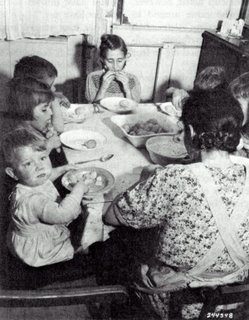
[photo: FAMILY MEAL, mostly of potatoes.]
The first postwar Christmas, dismal though it was, was not quite as bad as it might have been. The worst specimen of a goose for the holiday dinner cost at least a thousand Reichsmarks, when one could be had at all; and one black marketeer made a huge profit selling cans of old Wehrmacht sauerkraut relabeled goulash. The Frankfurter Rundschau described the scene in that city:
A few stalls stand on the wet pavement of the main square in the midst of the ruins. Cards are for sale, also a few red and blue pencils, some cardboard toys, a few pitiful things made out of wood, and lots of trashy and expensive ornaments. The old Frankfurter Santa Claus and his arks full of wooden animals is distant as a dream.
In Stuttgart, the Christmas selection consisted mostly of small and expensive wooden toys and small quantities of powder, lipstick, and oilless face creams. A lighted Christmas tree atop the Stuttgarter Zeitung building, the first seen in the city since 1938, stood out painfully amidst the dark ruins.15 The weather, however, was warm and springlike. The Frankfurter Rundschau reminded its readers what such weather meant in terms of survival and recalled also that the previous year had been different in two respects: the weather on 24 December had been cold and the sky clear, and a hail of bombs had fallen on the city. This year at least "no mother needs to pick up her child in haste and run to the cellar with it."
The holiday was, in fact, not completely barren. Third Army reported "a certain aura of good feeling" associated with the season, and the food offices released extra rations of sugar and flour. Throughout the zone, the troops gave Christmas parties for children. In Landkreis Wetzlar, for example, the local detachment and the occupation troops gave a bag of cookies and a candy bar to each of the several thousand school children. In Bad Aibling the officers and men of the guard for Prisoner of War Enclosure No. 26 distributed chocolate and candy in the town schools. In Heilbronn, the US soldiers furnished candy, the prisoners of war in the local stockade contributed handmade toys, and the military government detachment recorded with satisfaction "the presence of a traditional Christmas tree in even the humblest cellar home." Some detachments noted, however, that the Germans who came around to them with holiday greetings were often small-time Nazis hoping to ingratiate themselves, while those who had nothing to fear or nothing to gain stayed away.
Sunday, December 07, 2008
"Air Raid on Pearl Harbor. This is no drill." 1941
Pearl Harbor December 7 1941
Chronology Of The Attack
From The Deck Logs Of The Vessels Moored At Pearl Harbor December 7 1941
Compiled For The Pearl Harbor, Court Of Inquiry Hearings
0743 Local hostilities commenced with air raid on Pearl.
O757 PATRON 21 First Bomb dropped near VP-22 Hangar. Message order broadcast to all ships present "AIR RAID P. H. X THIS IS NOT DRILL" (a similar message was sent by CinCPac).
0812 OUTGOING Hostilities with Japan commenced with air raid on Pearl.
0812 Task Force 8 received message from CinC Air Raid on Pearl Harbor. This is no drill. This time about coincided with expected arrival ENTERPRISE planes at Pearl. Task Force Comdr. first concerned that planes were assumed to be unfriendly by harbor defenses. It was not until subsequent dispatches were received that it was realized hostilities with Japan had begun.
1322 Opnav To Mardet Tientsin. Com 15, Mardet AM Emb, Peiping Astnavatt
Shanghai, Rdo Wake, Navatt Chungking, Johnston Is, Rdo Guam, Palmyra, Com 16, Rdo Tutuila, HOPKINS: This confirms air raid by Japan on Oahu at 1800 today followed by declaration of war by Japan against US and Great Britain.
For those on the west side of the international date line, the "date which will live in infamy" came on 8 December 1941. Few responsible military or naval men had believed that the Japanese would be able to strike in more than one place. The number and diversity of their attacks took the Allies completely by surprise. During the early morning hours of the 8th, Japanese naval and air forces struck almost simultaneously at Kota Bharu in British Malaya (0140), Singora, just across the border in Thailand (0305), Singapore (0610), Guam (0805), Hong Kong (0900), Wake, and the Philippines.
The duty officer at Asiatic Fleet headquarters in the Marsman Building in Manila on the night of 7-8 December (Philippine time) was Lt. Col. William T. Clement, USMC. At 0230 of the 8th (0800, 7 December, Pearl Harbor time), the operator at the Navy station intercepted the startling message, "Air Raid on Pearl Harbor. This is no drill." Recognizing the technique of the sender, an old friend stationed at Pearl Harbor, the operator brought the message to Colonel Clement. Within a half hour, it was in Admiral Hart's hands. He broadcast the news to the fleet immediately, and then, with his chief of staff, hurried to his office.
Shortly after 0330 General Sutherland received the news of the Pearl Harbor attack, not from the Navy but from commercial broadcasts. He passed the news on to MacArthur over the private wire to the general's penthouse apartment in the Manila Hotel, then notified all commanders that a state of war existed with Japan.
Friday, November 21, 2008
the Ghost of Christmas Past
With Christmas present approaching.
At A Christmas Carol by Charles Dickens we can read:
"Who, and what are you?" Scrooge demanded.
"I am the Ghost of Christmas Past."
While at Chapter 4 – Organised for Total War, April 1942–June 1943 we can read:
"A SEASON OF AUSTERITY” 271
I am no believer in the fear psychology (Prime Minister Curtin said in a national broadcast) but if we do not strip ourselves to save our country, then the enemy will do it with a ruthless efficiency and with a maximum of misery that can have a counterpart only in the imagination. Consider our fate should he be victorious! What will we have then? Today Port Moresby and Darwin are the Singapores of Australia. If those two places fall, then, inevitably, we are faced with a bloody struggle on our soil when we will be forced to fight grimly, city by city, village by village, until our fair land may become a blackened ruin. We will fight. Our record is proof of that, but what of the cost? Therefore, the Australian Government says that the cost must be paid now —not to an invading enemy —but in equipping our fighting men so that they will hold Port Moresby and Darwin; so that they will hold this Australian bastion for democracy and, finally, wrest the initiative from the enemy.
Our fate is in the balance as I speak to you. The Battle of the Solomons is not only vital in itself, but, as part of a continuing action which will go on, it represents a phase of the Japanese drive in which is wrapped up invasion of Australia. At this stage it would be mischievous to conjecture as to whether the outcome of the Battle of the Solomons will give us a further breathing space or whether it will mean disaster, followed swiftly by a direct Japanese threat and thrust at our shores .But I do tell you that we are faced with an enemy of great power, devilish ingenuity and regimented efficiency. We cannot expect to rely on strokes of luck nor to survive mistakes. The Japanese are waging war to the death. We seven millions of Australians in this, the place where are gathered the greatest number of British-speaking people south of the Equator, must, individually, wage a war to the death, just as though we were, man for man, engaged in bloody combat.
The Government, therefore, cannot permit anything to stand in the way of placing the nation on a full war footing and it must, by every means in its power, bring those sections ...who are thoughtless of what is involved to a salutary realisation of the situation. To that end, Cabinet has made decisions which will be the Government's lead in the austerity campaign which is opened as from tonight.
The specific measures which were ushered in by this account of the war situation were intended to restrict horse and dog races, raise the tax on all entertainments, reduce drinking, smoking and the eating of expensive meals, check black-marketing and take away the glamour from the "artificial life" led by those people whose doings are described as social news.
It was plain, however, that the Prime Minister had planned an eloquent speech for other reasons than to announce such decisions. His main objective was "to bring the people to the realisation that only by an austere way of life can we muster our national strength to the pitch required for victory". He read out a pledge which he asked every Australian to take in order that they might strip themselves of "every selfish, comfort-able habit, every luxurious impulse, every act, word or deed that retards the victory march". The pledge, in six short paragraphs, was an emotional recital rather than a precise commitment — a promise to fight and work as Australians had never fought or worked before, to cut from life "every luxury, every relaxation, every temptation to slack", to forget privileges, comfort and rest and, throwing everything into the struggle, let nothing block the way to the attainment of victory.
Against the fervency of his appeal and the rigidity of the code he imposed on himself, the various executive acts by which the austerity campaign was enforced on the people may seem banal. They were rules to curb spending and perhaps make the citizens worthier in the process. The first action was against racing. The purpose was both to check the orgy of betting that had come with the increased circulation of money and to cut down the claims of the racing industry on men, supplies and transport. The State Governments were asked to use the power given to them by the Commonwealth to restrict further the number of horse-racing, greyhound coursing and trotting meetings. None of the States did so. Curtin himself, after hearing representatives of the racing clubs and resisting various pressures, brought down proposals to the Full Cabinet. The final decision was to have races only on Saturdays, to have one raceless Saturday each month, to limit the number of events on a race programme, and to restrict the publication of form, comments and tips. The big holiday and carnival meetings in each State were exempted from the regulations. 5 Later, restrictions on the transport of racehorses and greyhounds were introduced. Attempts, with an extremely limited success, were also made to check off-the-course betting by "bootleg bookmakers". The war effort of race promoters and racegoers, however, was chiefly in the endurance of difficulty to maintain their customary habits. The next attempt was to reduce "the disproportionate expenditure on drink". A previous attempt had been made by the Minister for War Organisation of Industry to save manpower, conserve materials and reduce excessive drinking and drunkenness by restricting the production of beer and other alcoholic beverages by amounts of from 28 per cent to 331-per cent according to the class of residential area, and by limiting the hours of trading in liquor to seven a day. The Minister for Trade and Customs made a note on a file that this attempt cost his department the time spent in handling 6,038 letters, 8,150 telephone calls and 5,280 interviews and did not stop excessive drinking. Production had been cut in the April-June quarter of 1942 from 9,373,000 gallons to 7,201,000 gallons a month. There were mixed views in the party whether the restriction should continue but the Full Cabinet had decided to adhere to it on 3rd August 1942, and at a Premiers' Conference on 10th August the State Governments undertook to reduce trading hours by at least another hour a day, to impose drastic penalties on hotel-keepers for serving men in uniform with excessive quantities of bottled liquor, to exclude women from public bars, to make drinking in parks and public places unlawful an d to tighten up the laws in other respects . Curtin's austerity proposals were to use the deterrent effect of a substantial increase in excise and to inform the States that if their measures did not succeed the Commonwealth Government would introduce other measures.
The attempts to restrict drinking were resisted and evaded. They saved some manpower and materials in the breweries but may have lost manpower not only to black marketing but by reason of the fact that drinkers either waited for the beer to come "on” or, when it was "on " hastened to the pub so as not to miss their share. They made it difficult and in some cases impossible for some sections of the community to obtain liquor. They made no perceptible difference to excessive drinking, and drunkenness in public places continued to be a common feature of Australia n city life throughout the war. The political pressure in respect of both racing and drinking was constant and unvaried. It came from those who had ownership in the two industries; it came from the customers. It came from trade unions and from the wealthy. Wartime experience makes it clear that beer and betting mean more than anything else in life to a considerable number of Australians. Meals in public eating places were limited to three courses in order to check luxury spending. The newspapers were asked to give up printing social news or photographs of persons not engaged in war activities. Penalties for breaches of the prices regulations were made stiffer. A Black Marketing Bill was introduced into Parliament in September. Its title was not well chosen for what it did was to provide more drastic punishment for all the major offences already constituted under the National Security Regulations dealing with prices, liquid fuel, rationing of goods and services, the restriction of stocks and the control of production an d the acquisition of primary products. It was really a measure designed t o check any form of excessive profit-making or evasion of the controls mentioned. It was passed with the blessing of both parties
And at Chapter 4 – Organised for Total War, April 1942–June 1943 we can see another Scrooge.
"Mr. Dedman Scrooge has banned Christmas advertising, the words 'Yuletide' and
'festive season' and the employment of Santa Claus in shops . "

Tuesday, November 11, 2008
The 9th Australian Division Versus the Africa Corps
The 9th Australian Division Versus the Africa Corps:
An Infantry Division Against Tanks--Tobruk, Libya, 1941
At the time, the Australians' epic stand at Tobruk had a major impact on the war because the Germans suffered a serious and unexpected reversal. The Tobruk garrison demonstrated that the hitherto successful German blitzkrieg tactics could be defeated by resolute men who displayed courage and had the tactical and technical ability to coordinate and maximize the capabilities of their weapons and equipment in the defense.
Wednesday, November 05, 2008
American people were overwhelmingly isolationist
PACIFIC STRATEGY
At the turn of the twentieth century, after the war with Spain, the United States for the first time in a hundred years found itself involved closely in the affairs of other nations. The American people were overwhelmingly isolationist and unwilling to pay the price of colonial empire. It is against this background that American strategy in the Pacific and plans for the defense of U.S. island outposts must be viewed; it explains many of the seeming inconsistencies between policies and plans.
At the turn of the twentieth century, after the war with Spain, the United States for the first time in a hundred years found itself involved closely in the affairs of other nations. The American people were overwhelmingly isolationist and unwilling to pay the price of colonial empire. It is against this background that American strategy in the Pacific and plans for the defense of U.S. island outposts must be viewed; it explains many of the seeming inconsistencies between policies and plans.
Wednesday, October 29, 2008
Germany-1946
Recent economic events have been portrayed as new, as below shows nothing has changed.
CHAPTER XXIII - Winter - The Season of Despair
Occ-GY/ch23
From the first sight in the spring of unplowed fields, shutdown coal mines, and ruined cities, the winter to come had loomed ominously in the minds of those who would be responsible for administering the occupied country. In June, predicting a barren winter for Europe, the Potter-Hyndley Mission contemplated a possible need "to preserve order by shooting" [emphasis added] in Germany.
Subscribe to:
Posts (Atom)